
Quarterly Economic Survey
Q3 2026 Executive Summary
DOMESTIC SALES
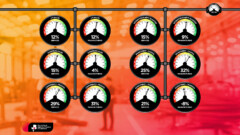
A mixed bag with both sectors having diverged in terms of sales growth. Manufacturers continued their impressive growth trajectory with a fourth consecutive quarter of sales increasing while the service sectors strong performance so far in 2026 having slipped slightly.
Both sectors should be looking to a healthy final quarter of the year with order books for both manufacturers and services sector firms surging.
EXPORT SALES
Following a weak second quarter, both sectors posted a strong improvement in their overseas sales performance. Manufacturers ended several quarters of decline while the service sector kept its strong recent performance going. Export orders also looking very healthy with big improvements across both sectors.
INVESTMENT
Capital investment intentions have become increasingly divided between the two sectors. Service firms reported a substantial improvement in investment plans, reaching their strongest level for nearly two years. Manufacturers, however, moved back into negative territory, suggesting continuing caution despite signs of improving demand. Overall, business investment remains positive but is being driven largely by the service economy.
Training investment remains positive across both sectors. Service-sector firms increased training expenditure further during Q3 and remain strongly focused on skills development. Manufacturers also continued to invest in training, although at a much lower level than services and with less momentum than the previous quarter.
EMPLOYMENT
Q3 of 2026 saw an much improved performance across both sectors with hiring intent having improved after months of being flat. Going forward service sector firms remain bullish about the plans to recruit while manufacturers slipped backwards, possibly driven by increasing overheads.
BUSINESS CONFIDENCE
Expectations around future turnover strengthened during Q3. Service firms reported a strong improvement in confidence, supported by robust sales and order growth. Manufacturers also became more optimistic, although confidence remains considerably lower than in the service sector. Overall, firms are looking ahead with greater confidence than earlier in the year.
Profitability expectations also improved during Q3, with service firms reporting a further increase in confidence as stronger demand begins to offset cost pressures. Manufacturers also recovered from the negative position recorded in Q2, but confidence remains flat overall. The result is a widening confidence gap, with service businesses continuing to underpin regional business sentiment
COSTS AND CONCERNS
Cost pressures remain widespread in the region. Manufacturers continue to face significant challenges from raw material, energy and transport costs, while service firms remain most affected by labour costs and taxation. Competition, taxation and rising inflation are among the leading external concerns facing businesses. Although demand conditions have improved, cost pressures remain elevated and continue to weigh on profitability, particularly in manufacturing
The Quarterly Economic Survey is one of the longest running and widest scoping business surveys in the UK. It provides a useful picture of the state of business in the UK at a national, regional and local level.
Nationally, tens of thousands of businesses answer the survey, and this is the opportunity to be part of that.
We ask a mix of standing questions which give a perspective of how trade, labour, business confidence and other metrics have fluctuated. We also ask specific questions each quarter on hot topics that members are interested in, including AI, the impact of global conflicts and the Covid-19 pandemic.
From there, we present this data to local councils, combined authorities and it forms part of the picture that goes to national government with the wider British Chambers of Commerce.
On this page, you will find links to previous Quarterly Economic Surveys, to see the details of what businesses tell us.